Supreme Court to hear Trump tariff arguments Nov. 5
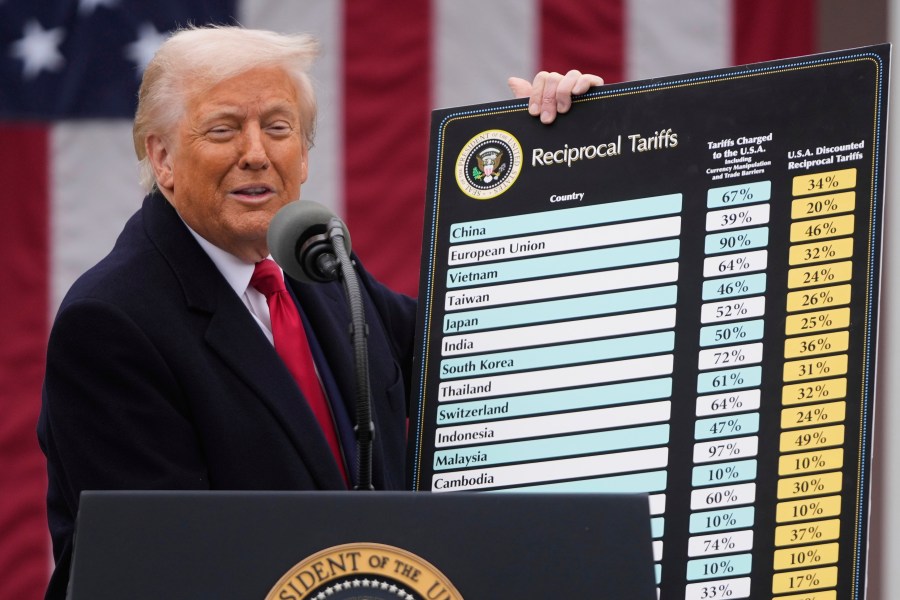
The Supreme Court will consider whether President Trump can use emergency powers to justify his sweeping tariffs worldwide on Nov. 5, the court announced Thursday.
The official scheduling of the oral arguments comes a week after the justices agreed to hear the Trump administration’s appeal and fast-track the cases, which have broad implications for the president’s efforts to refashion global trade.
To squeeze the tariff arguments into its schedule, the justices moved arguments in two other cases: one involving a question of civil procedure to the day prior, Nov. 4, and another regarding how multiple IQ scores factor into a person’s death penalty eligibility to a date that has not yet been set.
Cases granted at this time of the calendar are usually set for oral arguments early next year, but the parties convinced the justices to move quicker.
The administration argued Trump’s tariffs are his “most significant economic and foreign-policy initiative.” The justices will hear appeals in underlying cases regarding whether the International Emergency Economic Powers Act (IEEPA), which Trump invoked, authorizes them.
Enacted in 1977, IEEPA authorizes the president to issue certain economic sanctions to counter an “unusual and extraordinary threat” in an emergency.
Trump is the first president to have attempted to impose tariffs by invoking the statute, citing it in February to announce levies on Canada, China and Mexico, and pointing to the fentanyl crisis.
Then, in April, he called an emergency over trade deficits a reason to expand that to a 10 percent global baseline tariff, with higher rates for some countries — a move he deemed “Liberation Day.”
Last month, the U.S. Court of Appeals for the Federal Circuit in a 7-4 decision affirmed a lower court’s ruling that the tariffs were not authorized by the statute.
That lawsuit was brought by five small businesses and a dozen Democratic-led states. The Supreme Court additionally took up a similar petition filed by other small businesses challenging Trump’s tariffs that won before a federal district judge in Washington, D.C., but asked the high court to immediately get involved to settle the issue.
Until the Supreme Court rules, Trump’s tariff policy can stay in place pending its decision.