Union reaches historic agreement at EV battery plant
Sustainability
Sustainability
<!–
The Big Story
Union reaches historic agreement at EV battery plant
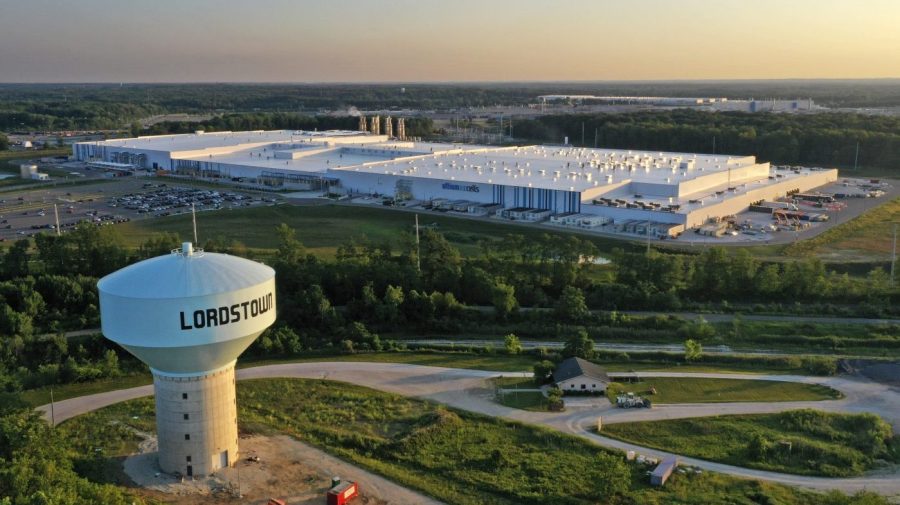
Workers at the nation’s first electric vehicle (EV) battery plant to unionize have reached an agreement with management on Monday.
© AP Photo/Gene J. Puskar
If ratified by members, the new deal will double the pay of workers at the Ultium plant in Lordstown, Ohio, a joint venture between General Motors (GM) and Korea-based LG Energy Solutions where workers build standardized battery platforms that will form the core of GM SUVs, cars and trucks.
“This local agreement is the culmination of thousands of UAW members and leaders who said we’re not going to take it,” union president Shawn Fain wrote on Monday.
In addition to the pay hike, the deal will give workers new safety protections — and, leaders of the United Auto Workers (UAW) hope, create a model for future union penetration into the EV sector.
Lordstown has been a charged and evocative battle for the UAW: A community gutted by what Fain called “a race to the bottom” made possible by the push from the labor-intensive construction of internal combustion cars to the largely automated production of EVs.
In 2019, GM closed the Lordstown conventional auto plant, where workers had made about $30 an hour — only to break ground on the new Ultium plant in 2020.
But when workers began at the new battery plant, they made just $16.50 an hour — to do a job which included exposure to caustic chemicals with unknown health impacts.
“The Big Three automakers: Ford, General Motors, and Stellantis, are taking billions of dollars in government subsidies to go electric,” Fain said last year, as UAW members went on strike across the three companies. “But those benefits aren’t trickling down to UAW members.”
In 2022, just after production at the Ultium plant began, 93 percent of workers voted to join UAW.
“It was a high mark to hit — the highest I’ve ever seen,” local union president David Green told The Hill.
The former union head at the now-closed GM plant, Green had the dubious distinction of being personally attacked on social media by then-president Donald Trump when he fought to keep the plant open.
“When you see one of those factories close — it really kills the community,” Green told The Hill. The reopened Ultium plant “is now breathing life back into the community.”
But the new plant came with less money and new risks. To The Hill, Green described caustic chemicals coming into the plant in burlap sacks labeled in Korean, which members couldn’t read. “We didn’t know what it was or how to identify it.”
In 2023, the plant was cited and fined by federal regulators for exposing workers to “machine and chemical hazards.”
As part of the new deal, members get four health and safety representatives in the plant — more than a usual plant.
And in a pivotal part of the agreement, won as part of the UAW strike campaign last year, the workers will be treated as GM employees, contracted out to Ultium — rather than being an isolated Ultium-only union.
That will help workers with the “just transition to EVs,” Green said — creating a path for conventional auto workers to filter over to good EV-manufacturing jobs as sales of internal combustion engines declines. If they leave Ultium, “they can move to another facility because covered under GM national agreement.”
In particular, he said, the doubled wages would trickle to local business and governments. “Local restaurants, barbershops that have closed will start to reopen. The tax base coming back in. No mistake, $35 an hour, you’re paying 2x taxes as if $16 an hour. It’s good for the police, fire, schools.”
The pay raise, he said, is “good for our workers, absolutely. But I can’t stress enough how good it is for the community.”
“And all because we stopped that race to the bottom.”
Welcome to The Hill’s Sustainability newsletter, I’m Saul Elbein — every week we follow the latest moves in the growing battle over sustainability in the U.S. and around the world.
Did someone forward you this newsletter? Subscribe here.
Essential Reads
Latest news impacting sustainability this week and beyond:
The historic practice of redlining may have led to the redistribution of wildlife populations in four of California’s largest cities, a new study has found. Neighborhoods that were subject to the discriminatory practice in Los Angeles, San Diego, San Francisco and Oakland all have less native and non-native wildlife biodiversity compared to that of greenlined areas, according to the study, published on Tuesday in the Proceedings …
New York police arrested dozens of climate activists dressed as orcas Tuesday morning in front of the Citigroup headquarters as they protested the bank’s ongoing investment in fossil fuel expansion, according to group Climate Defenders. “Arrests continue at [Citibank] because wanting corporations to put planet over profit is a crime,” activists wrote Tuesday morning on the social platform X. That caption went out above …
Two Colorado lawmakers are pressing the Environmental Protection Agency (EPA) to scrutinize existing and proposed pollution permits at three Utah oil transport facilities, whose expansion they fear could endanger residents and wildlife across state lines. The enlargement of the Wildcat Loadout, the Price River Terminal and the Savage Energy Terminal would boost daily export capacity in Utah’s Uinta Basin from the current …
Rising human exploitation of the oceans is pushing ever further into regions that scientists increasingly suspect are full of conscious life. New research into creatures from sperm whales to octopuses, reef fish to hermit crabs, suggests that wide swaths of the undersea world may be populated by animals that have forms of consciousness something akin to those in humans. Those findings are coming alongside …
Biofuel Pollution
Biofuel plants are major polluters, report finds
© AP Photo/Stephen Groves
The biofuel industry is built on the idea that by blending petroleum-based fuels with ones made from plants, American auto travel can be made more sustainable.
But biofuel plants are nearly as polluting to the communities that house them as petroleum refineries, according to a new report from the Environmental Integrity Project (EIP).
The number of biofuel refineries has boomed since early 2005, when Congress passed the Energy Policy Act, which mandated blending of corn- and soy-based fuels with gasoline.
According to EPA data, biofuel refineries release 92 percent as many pounds of hazardous pollutants as oil refineries.
For some pollutants — like hexane, acetaldehyde and acrolein — biofuel refineries put out significantly more pollutants than their petroleum-based counterparts, the EIP report found.
For example, the Archer Daniels Midland plant in Decatur, Ill., is the nation’s largest emitter of hexane, a chemical that can lead to nervous system damage in people exposed over long periods of time, according to the EIP report.
More than a third of the nation’s biofuel plants have also failed EPA “smokestack tests” over the last five years, the report found. Some have failed multiple times. Grain Processing Corp of Muscatine, Iowa, has failed 16 times in four years.
On Our Radar
Upcoming news themes and events we’re watching:
Members of two Lakota nations and their supporters are pushing Biden to shut down the Dakota Access Pipeline (DAPL), which was built on the traditional territory of the Standing Rock Sioux Tribe in 2017.
In Other News
Branch out with different reads from The Hill:
Climate change protesters are hoping to “shut down” the annual Congressional Baseball Game on Wednesday night.
The California Fish and Game Commission has finalized a regulation prohibiting the larger Department of Fish and Wildlife from using certain toxic insecticides on lands under its jurisdiction.
Around The Nation
Local and state headlines on sustainability issues:
Another Blowout Adds to Mystery of Permian Basin Water Pressure (Inside Climate News)
Climate change linked to rising home insurance rates in Minnesota (Minnesota Public Radio)
What We’re Reading
Sustainability news we’ve flagged from other outlets:
Environmental Group to Study Effects of Artificially Cooling Earth (The New York Times)
Why scientists fear a second Trump term, and what they are doing about it (The Washington Post)
What Others are Reading
More stories on The Hill right now:
U.S. history scores on the assessment have continued to decline since 2014. Read more
The share of Americans who say they’re likely to buy an EV is down from a year ago, according to a new AAA survey. Read more
What People Think
Opinions related to sustainability submitted to The Hill:
Plastics producers are following Big Tobacco’s playbook, and we’re all paying the price
You’re all caught up. See you next week!
Check out The Hill’s Sustainability page for the latest coverage.
If you believe this has been sent to you in error, please safely unsubscribe.