Everything you need to know about Trump's big week in court – Raw Story
Sarah Burris is a long-time veteran of political campaigns, having worked as a fundraiser and media director across the United States. She transitioned into reporting while working for Rock the Vote, Future Majority and Wiretap Magazine, covering the Millennial Generation's perspective during the presidential elections. As a political writer, Burris has had bylines at CNN, Salon.com, BNR, and AlterNet and serves as a senior digital editor for RawStory.com.
Women in Media Cente
This week begins a big week for Donald Trump as he deals with some of his cases having major deadlines and in-court meetings.
The first date unfolds on Monday, when the Georgia racketeering case lawyers must file all their motions, Lawfare's "Docket Watch" details. That is, except for Mark Meadows, Jeffrey Clark and David Schafer. Rudy Giuliani has sought to extend the deadlines, but was denied.
On Tuesday, oral arguments begin at the Washington, D.C. Circuit Court of Appeals, where Trump will argue that he has universal presidential immunity from all criminal behavior conducted while president as outlined in the Constitution. Trump said that he will attend this trial.
It is expected to fail, which is one of the reasons that special counsel Jack Smith asked that they simply bypass the federal appeals court for the Supreme Court. But the High Court struck him down, demanding he follow the long and winding road of litigation. Former Justice Department official Mary McCord speculated that the Supreme Court may try and figure out a way to dodge ruling on it entirely if the D.C. court writes its ruling the right way.
So, the D.C. Appeals Court moved at what is, for them, lightning speed, to ensure that the case was brought up quickly. If it is denied, the only option Trump has is for the Supreme Court to put a stay on the case until they decide whether or not to take it up. It's something Trump's lawyer, Alina Habba, confessed he's worried about.
If there is no stay, Trump's lawyers must begin working on everything Smith has filed in the past several weeks. Trump's lawyers were furious at Smith last week for turning over evidence despite the stay. They've asked that he be "held in contempt" and forced to pay some of Trump's legal fees.
Also, on Tuesday, there is a "joint discovery status report" due for the classified documents case. It's likely to lead to more questions about Judge Aileen Cannon's delay tactics.
"All told, by latest numbers, the Court is advised that this case involves approximately 1.3 million pages of unclassified discovery, approximately 60 terabytes of closed circuit television footage spanning at least nine months, and 5,500 pages of classified discovery," says the nine-page "revised schedule" from Judge Aileen Cannon on November 10, 2023.
"I think it's been a little bit baffling to watch some of the judges like Aileen Cannon and the Florida Mar-a-Lago related criminal prosecution, where she has been playing, you know, slow-ball. I think some people would call it death-ball, trying to keep that case from going anywhere," said former prosecutor Joyce Vance.
On Sept. 14, 2023, the Justice Department filed its joint discovery report with the defendants for the case, as Lawfare pointed out.
Tuesday will also mark the date for the supplemental briefing on whether plaintiffs have standing in Oregon over Trump's challenge to the ballot due to Section 3 of the 14th Amendment.
Thus far, Trump has asked that the Supreme Court weigh in on Colorado's decision, as other states are following the lead.
Trump gets a day off on Wednesday.
Thursday, however, the final arguments will take place in the civil fraud trial in New York against the Trump Organization. Judge Arthur Engoron has already ruled that the ex-president was liable for fraud, but he will rule on how much Trump will be forced to pay in damages.
Attorney General Letitia James is seeking about $250 million in fines and penalties, but former Trump lawyer Michael Cohen believes that with interest, it could be more. In a filing last week, Cohen was proven correct, as James said that with pre-trial interest, it would be close to $370 million.
Trump has been under a gag order against attacking Judge Engoron's staff, so after the court has ruled, he is expected to launch further attacks on Engoron's clerk. It's unclear whether or not she will seek her own defamation litigation against him once the case is over.
Trump is expected to appeal the ruling once it's finalized. The New York Appeals Court has already upheld Engoron's ruling that Trump was liable for fraud.
Nothing else unfolds until a week from Monday, January 15, when Trump is likely to win the Iowa caucuses.
Former President Donald Trump asked a court on Monday to dismiss Fulton County District Attorney Fani Willis' case against him by claiming "absolute immunity" for any actions he took as part of his official duties as president.
Michael Anthony Kreis, a law professor at the Georgia State University College of Law, examined Trump's filing — and quickly concluded it wasn't worth the paper it was written on.
In particular, Kreis highlighted a Trump claim that trying him in Fulton County on racketeering charges would violate the United States Constitution's prohibition on trying a defendant twice for the same crimes.
"Trump moves to dismiss the Fulton case because, he claims, trying him for election crimes in Georgia after the 2020 election violates Double Jeopardy: he was already impeached and tried in the Senate for inciting an insurrection," Kreis wrote on Twitter. "This is so meritless it borders on the comical."
DON'T MISS: ‘Inconceivable’: Telemarketing ‘scam PAC’ tycoon bemoans his ‘intolerable’ jail conditions
In the first place, the Constitution makes clear that impeachment is a political process that does not preclude the possibility of also criminally charging a president once he's out of office.
What's more, even if this were not the case, it would not be double jeopardy for Trump to face state-based charges given that the impeachment process is done at a federal level.
And finally, noted Kreis, Trump was not charged federally with the crimes that Willis is alleging that he committed in his efforts to fraudulently overturn the results of the 2020 presidential election in Georgia.
In conclusion, Kreis wrote, "it would be absurd" for any court to accept this argument.
Read the whole thread here.
Attorney George Conway has penned a lengthy piece for The Atlantic in which he takes President Donald Trump's lawyers to task for their arguments in favor of keeping him on Colorado's Republican primary ballot.
In particular, he noted that Trump's petition to the United States Supreme Court about his ballot eligibility "didn’t conform with the ordinary rules and practices" and instead asks what he describes as "a Cuisinart of a question" — namely, "Did the Colorado Supreme Court err in ordering President Trump excluded from the 2024 presidential primary ballot?"
Conway then speculated on several reasons why Trump's petition was structured in this way, and he said that two main reasons may be his own lack of high-quality lawyers, as well as those lawyers' need to please him rather than make effective legal arguments.
"The Cuisinart question reeks of narcissism," Conway argues. "It says: Look at what they did to me! So unfair! It translates easily from the original Trumpish: Wasn’t the Colorado Supreme Court so very, very mean to me?"
RELATED: Donald Trump’s un-American ploy for criminal immunity
However, Conway also believes that the underlying case for Trump here is fundamentally weak and he is baffled as to why the Supreme Court allowed the question proposed by Trump's petition to stand rather than demand it be broken down into more specific components.
At the end, Conway speculates that "the reason the Court had to take the Cuisinart question was because Trump and the GOP couldn’t find a dispositive legal proposition that the Colorado court clearly got wrong."
Read the full analysis here.
For the first time in five decades, an American lander is bound for the Moon following a successful launch — but the historic mission led by private industry is experiencing a technical issue that could derail it.
A brand new rocket, United Launch Alliance's Vulcan Centaur, lifted off from Florida's Cape Canaveral Space Force Station at 2:18 am (0718 GMT) for its maiden voyage, carrying Astrobotic's Peregrine Lunar Lander.
Peregrine separated as expected, powered up its systems and made contact with ground control.
But "unfortunately, an anomaly occurred which prevented Astrobotic from achieving a stable sun-pointing orientation," Astrobotic tweeted, adding teams are working on the problem and would provide updates.
While in orbit, Peregrine's top mounted solar panel stays pointed at the Sun to enable maximum power generation.
"The solar panel is utilized to provide battery charge and maintain lander and payload operations," the robot's documentation says. Power is needed to run the onboard computer, as well as its communications and flight control systems.
Peregrine is supposed to reach the Moon, then maintain an orbit for several weeks before touching down on a mid-latitude region of the Moon called Sinus Viscositatis, or Bay of Stickiness, on February 23.
Until now, a soft landing on Earth's nearest celestial neighbor has only been accomplished by a handful of national space agencies: the Soviet Union was first, in 1966, followed by the United States, which is still the only country to put people on the Moon.
China has successfully landed three times over the past decade, while India was the most recent to achieve the feat on its second attempt, last year.
Now, the United States is turning to the commercial sector to stimulate a broader lunar economy and ship its own hardware at a fraction of the cost, under the Commercial Lunar Payload Services (CLPS) program.
– Treacherous terrain –
NASA paid Astrobotic more than $100 million for the task, while another contracted company, Houston-based Intuitive Machines, is looking to launch in February and land near the Moon's south pole.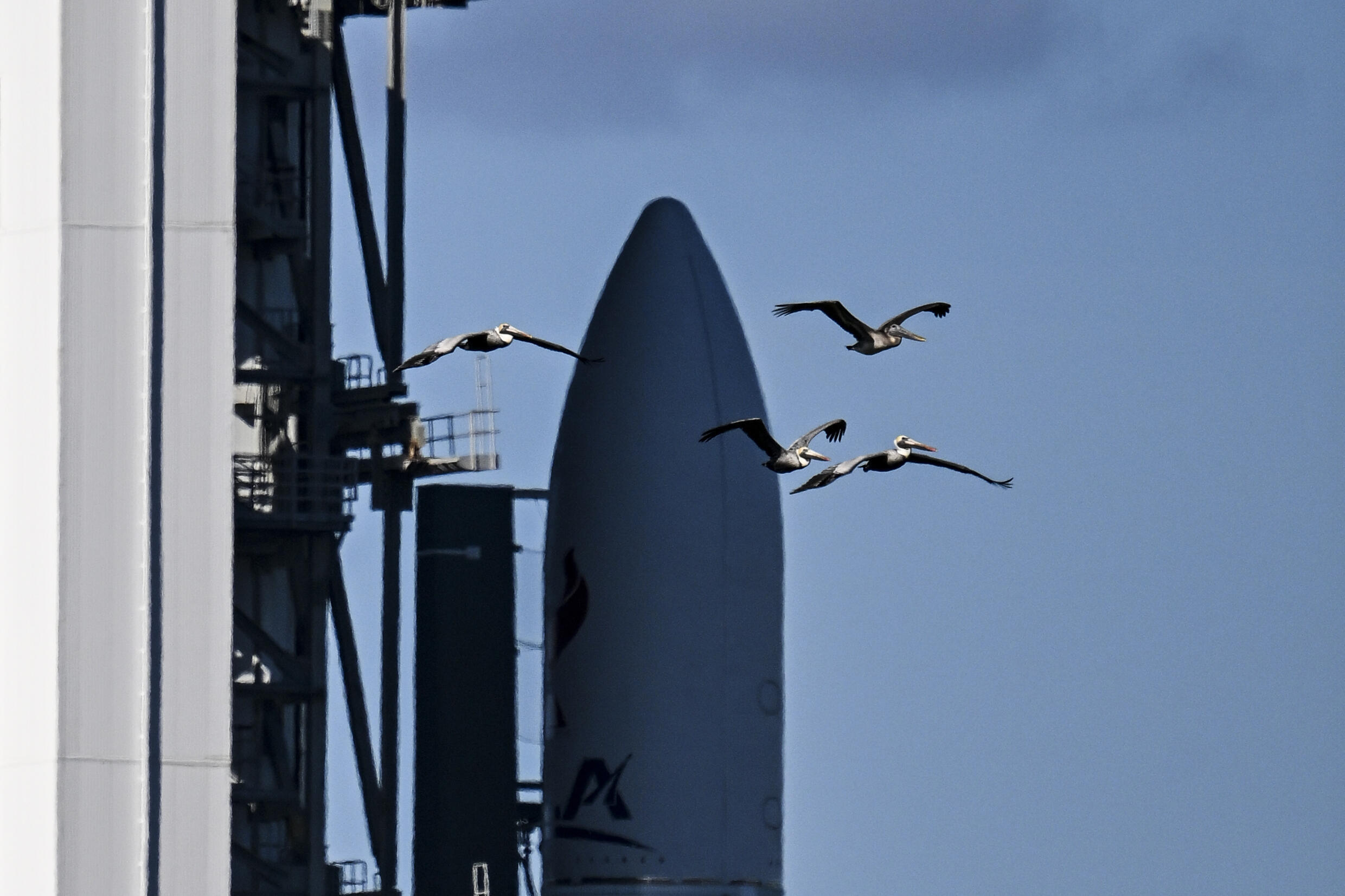 United Launch Alliance's new rocket blasted off on the first American attempt to land on the Moon in over a century © CHANDAN KHANNA / AFP
NASA says they will help pave the way for its Artemis program to return astronauts to the Moon later this decade, in preparation for future missions to Mars.
Controlled touchdown on the Moon is a challenging undertaking, with roughly half of all attempts failing.
In the absence of an atmosphere that would allow the use of parachutes, a spacecraft must navigate treacherous terrain using only its thrusters to slow descent.
Private missions by Israel and Japan, as well as a recent attempt by the Russian space agency, have all ended in failure — though the Japanese Space Agency is targeting mid-January for the touchdown of its SLIM lander launched last September.
It was the first launch for ULA's Vulcan rocket, maintaining the company's 100 percent success rate in more than 150 prior launches.
Vulcan is planned to have reusable first stage booster engines, which the company, a joint venture between Lockheed Martin and Boeing, expects will save costs.
On board Peregrine is a suite of scientific instruments that will probe radiation and surface composition, helping to pave the way for the return of astronauts.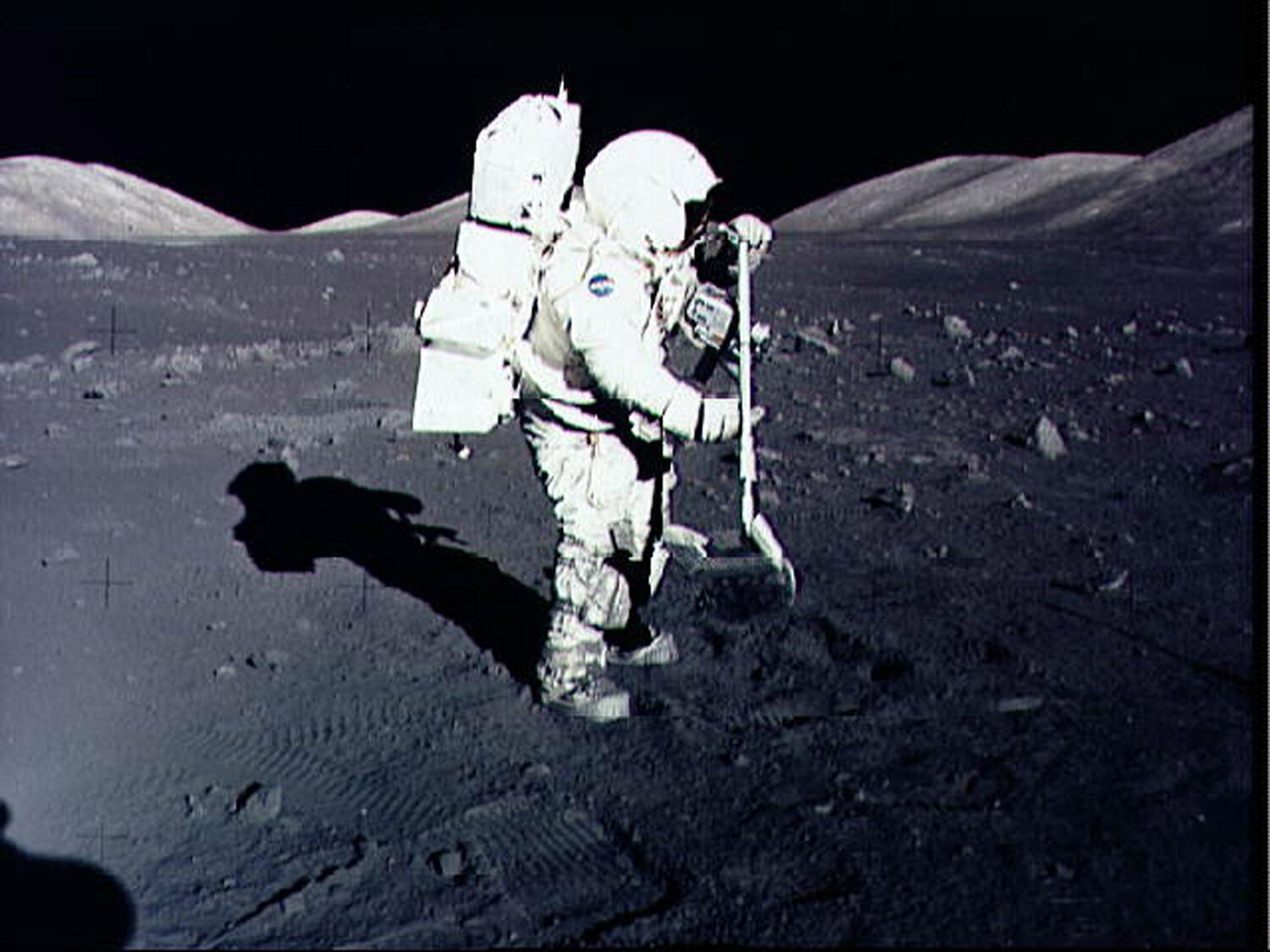 Astronaut Harrison Schmitt collects lunar rake samples at the Taurus-Littrow landing site on the moon during the Apollo 17 mission, America's last lunar landing © HO / NASA/AFP/File
But it also contains more colorful cargo, including a shoebox-sized rover built by Carnegie Mellon University, a physical Bitcoin and cremated remains and DNA, including those of Star Trek creator Gene Roddenberry, legendary sci-fi author and scientist Arthur C. Clarke and a dog.
The Navajo Nation, America's largest Indigenous tribe, has objected to sending human remains, calling it a desecration of a sacred space. Though they were granted a last-ditch meeting with White House and NASA officials, their objections failed to remove the cargo.
The Vulcan rocket's upper stage, which will circle the Sun after it deploys the lander, is meanwhile carrying remains of more late cast members of Star Trek, as well as hair samples of presidents George Washington, Dwight D. Eisenhower and John F. Kennedy.
© 2024 AFP
Copyright © 2023 Raw Story Media, Inc. PO Box 21050, Washington, D.C. 20009 | Masthead | Privacy Policy | Manage Preferences | Debug Logs
For corrections contact corrections@rawstory.com, for support contact support@rawstory.com.