Supreme Court won’t review pro-Trump lawyer’s disqualification from Dominion case
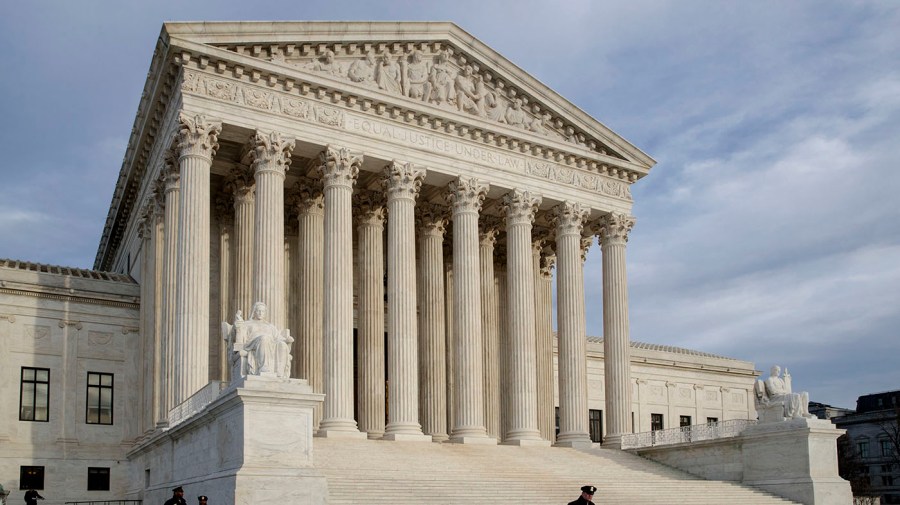
The Supreme Court on Monday declined to review the disqualification of an attorney accused of improperly accessing voting machines after the 2020 election as counsel in a defamation case brought by Dominion Voting Systems.
Michigan attorney Stefanie Lambert represented Overstock.com founder Patrick Byrne in the defamation suit brought by Dominion, a voting technology company that conspiracists homed in on in the wake of President Trump’s 2020 election loss.
She was removed from the case last year after a judge determined she publicly leaked internal records from Dominion in violation of a court order.
A lawyer for Byrne contended to the justices that Lambert’s apparent expertise in “election fraud” has made her a threat to Dominion, prompting the company’s bid to disqualify her from representing him in the case, even as she represents him in other litigation.
“Here, Petitioner’s counsel of choice is the leading expert attorney and primary counsel in election related cases across the country and other matters involving Respondent, including a breach of contract action,” lawyer Peter Ticktin wrote in Byrne’s petition to the court.
“Respondent’s motives are evident, because it continues to engage in reactive actions and conduct demonstrating its fear that Petitioner’s counsel will be able to continue to represent Petitioner in litigation with and involving Respondent,” he said.
There is no evidence of widespread fraud in the 2020 presidential election. Dominion waived its right to respond to Byrne’s petition.
Lambert faces criminal charges in Michigan over an alleged scheme to access voting tabulators following the 2020 election, as Trump’s supporters sought evidence that he won instead of former President Biden. She was scheduled to go to trial last week, but a judge pushed the proceeding to March.
Ticktin told The Hill that the case remains open for appeal that Byrne did not have the assistance of the attorney of his choice in the Dominion litigation. He also defended Lambert’s actions, saying she gave Dominion’s discovery file to law enforcement “as she was required to do so by statute” and describing her as responsible for preventing foreign election interference in the 2024 race.
“If you are wondering how it could be that people are claiming that the 2020 Election was stolen and Donald Trump was able to win in 2024, this is why,” he said. “This is all I can say on this issue at this time.”
Dominion Voting Systems was sold last month to Scott Leiendecker, a former Republican director of elections for St. Louis, Mo., and renamed Liberty Vote. The Hill reached out for comment.
“Does Dominion even exist anymore?” Ticktin asked, attributing its apparent disappearance to Lambert.
It was not immediately clear whether Trump’s sweeping pardon Sunday night for efforts to expose voting fraud would affect Lambert’s case.
Though Lambert is not named in the pardon, it grants a “full, complete and unconditional pardon to all United States citizens” for conduct relating to both the so-called “fake electors” scheme and “any conduct relating to their efforts to expose voting fraud and vulnerabilities in the 2020 presidential election.”
However, presidential pardons are limited to federal offenses, not state offenses, so it is not likely that she would immediately be absolved.
Updated at 12:24 p.m. EST